
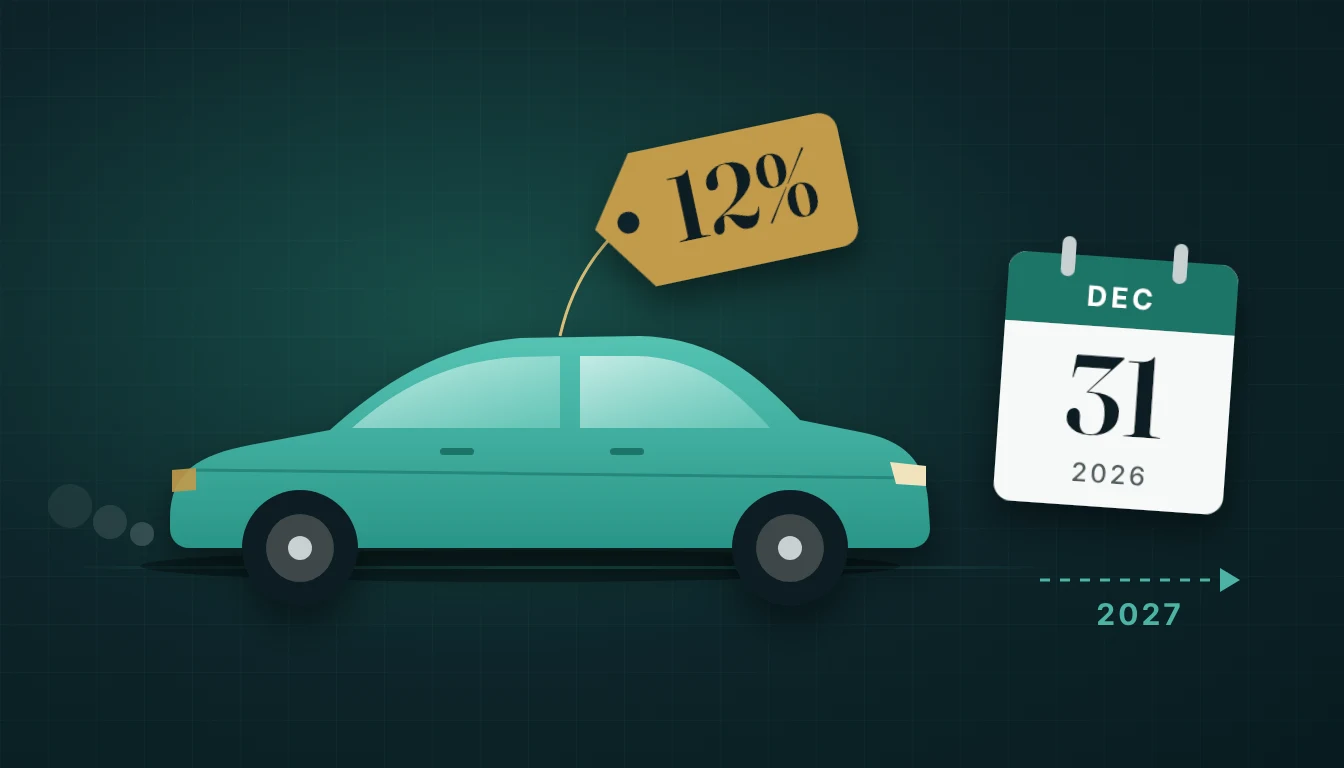
From 1 January 2027, employers pay an extra levy of 12% for every petrol, diesel, LPG or hybrid company car that is also used privately. For an average lease car, that quickly adds up to thousands of euros a year. If you still want to provide a car that is not fully electric, you have until 31 December 2026 to fall under the transitional rules. What does this mean for your business, and what can you still do?
What is the pseudo final levy?
The pseudo final levy (pseudo-eindheffing) is a charge on the employer, on top of the taxable benefit (bijtelling) the employee already pays. The employer pays 12% a year on the list price (including VAT and BPM) of a passenger car that is not fully electric, if that car is made available to an employee who may also use it privately. Commuting counts as private use.
“Pseudo” means the levy deliberately falls on the employer. You pay it through your payroll tax return, and you may not pass the cost on to the employee. The employee’s taxable benefit stays in place: the pseudo final levy comes on top of it.
If the employee may not use the car privately, not even for commuting, the levy does not apply. You must, however, be able to show that the car is not used privately.
Which cars are covered?
- Covered: passenger cars that are not fully electric: petrol, diesel, LPG and hybrid. Other vehicles treated as passenger cars for tax purposes can also be covered.
- Not covered: fully electric cars.
- Not covered: vans.
The levy applies to cars you make available to an employee for the first time from 1 January 2027. The car does not have to be new: a used car you start providing from that date is covered too.
What does it cost?
| List price (incl. VAT and BPM) | € 50,000 |
| Pseudo final levy, 12% a year | € 6,000 |
| Over a 4-year lease | € 24,000 |
That amount comes on top of the lease payments or depreciation, fuel and insurance. For a fleet of ten cars that are not fully electric, the total quickly reaches tens of thousands of euros a year.
The pseudo final levy is deductible for corporate income tax. That lowers the net cost somewhat, but it remains a significant extra expense.
Why 31 December 2026 matters: the transitional rules
Cars you made available to an employee before 1 January 2027 fall under the transitional rules. For those cars, you pay no pseudo final levy until 1 January 2031.
A few points to watch:
- Ordering is not enough. A signed contract or a placed order does not count. The car must actually be made available before 1 January 2027. A car delivered in January does not qualify.
- Within your company, the transitional rules stay with the car. If you give the same car to another employee, the transitional rules continue to apply.
- The employee moves to another employer with the car? Then they lapse. If an employee takes the car to a new employer, the transitional rules do not automatically go with it.
- Merger, acquisition or conversion to a BV. In a merger, a business acquisition, or when a sole proprietorship or general partnership (VOF) is transferred into a BV, the transitional rules are preserved. The State Secretary confirmed this on 16 October 2026.
- From 2031 you pay after all. If the lease of a car that is not fully electric runs into 2031, that car falls under the levy from 1 January 2031.
Exceptions
- Replacement car during repairs or maintenance. If an employee’s electric car is out of use because of damage, a breakdown or lengthy maintenance, you may provide a replacement car that is not fully electric for up to 14 consecutive calendar days without the levy. If the car is out of use again later, the exception applies again.
- Temporary rental car. Until 1 January 2031 you may, under conditions, use a rental car that is not fully electric, for example for a project or a busy period. This is allowed for up to 7 consecutive calendar days, once a year per car. Keep a record of the rental period and the reason.
- Driving schools. Driving school cars are exempt, because the category B driving test must also be possible in a car with a manual gearbox.
What can you do now?
- Map your fleet. Which cars that are not fully electric are on the road, what are their list prices and when do the contracts end?
- Decide on new non-electric cars before year-end. Can a car still be delivered and made available before 1 January 2027? Record the date it was made available.
- Compare the total cost with electric. With 12% extra a year, the numbers often look different than they did a few years ago.
- Check lease contracts that run beyond 2030. The levy applies to them after all.
- Update your car policy. Set out which cars employees can still choose and how you handle the extra cost.
Need help?
Would you like to know what the pseudo final levy means for your business, or are you unsure whether a car still falls under the transitional rules? Contact NBM. We are happy to run the numbers for you.